Community has always been super important to me. I see it as a group of people who start off as strangers and through connection and interaction eventually become friends in different capacities.
I moved to NYC at the age of 18 without knowing a single person. Aside from getting a job, I knew that making connections with an awesome group of people — my personal tribe — would be the most important factor in the kind of life I could build in such a big city. Looking around me now, it’s hard to imagine life without the wonderful humans I’m fortunate to call my friends.
The experience of building my personal tribe encouraged me to bring that same energy to work. Through my last job (shout out Packet!) I met some of my closest friends. Being able to work alongside folks who not only bring out the best in you professionally but you can also share a laugh in between—that's a top tier experience.
One of my superpowers is getting the most motley of crews together and finding our common ground. I'm a non-technical person in a very geeky industry, so learning from the people around me is hugely important, and a strong motivation for incorporating people of different backgrounds in everything I do. You never know who can lend you a hand or teach you something new!
Launching our Alt Cloud Meetups
At Datum, the spirit of connection is something we are intentionally trying to nurture.
One of our early bets last year was to start a meetup series focused on the needs of what we call “Alt Clouds”. We did an experiment in New York City, partnering with Vine Ventures and Headline VC, and immediately felt the good vibes. Maybe it was Erik Bernhardsson’s talk about how Modal makes its global AI infrastructure so darn fast, Jake’s hilariously understated talk about auth for agents (Authzed helps small companies like OpenAI figure this stuff out), or Tim Crawford’s “big money” view from Key Bank Mosaic about the specialized cloud market, but it was clear that people wanted to be together around this topic.
Working with our partners at ex/ante (in NYC) and Encoded and StepFunction (in Boston) we’re building upon those early experiments to bring together people who are building, thinking about, and working on the next wave of cloud infrastructure.
Our ingredients are pretty simple and size is an important factor. We aim for about 30 to 40 people at each meetup, and that number is intentional. It's big enough to get a real mix of perspectives in the room (engineers, founders, community folks, operators) but small enough that you actually have time to meet people. Nobody gets lost in a crowd. If you work at it, you can have a real conversation with almost everyone there, and that's the whole point. At least from my experience, that 30-40 person range is the sweet spot where genuine connections can happen.
What We've Learned So Far
Running meetups is just like any other event, but completely different!
The first part is getting the right speakers. You have to juggle creativity (what’s cool?) and savvy (what’s hot?) with logistics (who is available?) and connections (can we get them to come?). Happily, our partners have been huge helpers in making this happen.
In terms of the format, demos really matter. People come to these events because they want to see what others are building. A live demo does more to spark conversation than any panel discussion ever could. It gives the room a shared reference point and a reason to go up to someone afterward and say, "Hey, tell me more about how you did that."
We also learned that craft cocktails are fun (Justin Gage from Amplify is literally the GOAT!) but also a lot of work. We tried it at an early event and people absolutely loved making their own drinks, but the effort behind the scenes was significant. Especially if you care about good ice. :)
And then there's the food situation. Here's my public service announcement to anyone organizing community events: never order too much food. I know the instinct is to over-prepare because you don't want to run out, but trust me, you will end up with a mountain of uneaten pizza or fancy charcuterie that no one touches once the conversations get going. Order way less than you think you need. The right folks are there for the people, not the pizza.
Our Secret Ingredient: Mutual Aid
A marketing friend once told me that to get good things started you often need a “rockstar move.” For our meetups it has certainly been a short exercise we call Mutual Aid.
The concept is simple: at our meetups, we ask folks to fill out a notecard with something they might need from the group, and then we take 15 minutes after the presentations wrap to read through them together.
Need an intro to someone? Looking for your next big gig? Trying to hire for a niche role? Searching for that awesome honeymoon recommendation? A good spy novel for your bedside table? We’ve had some wild ones!
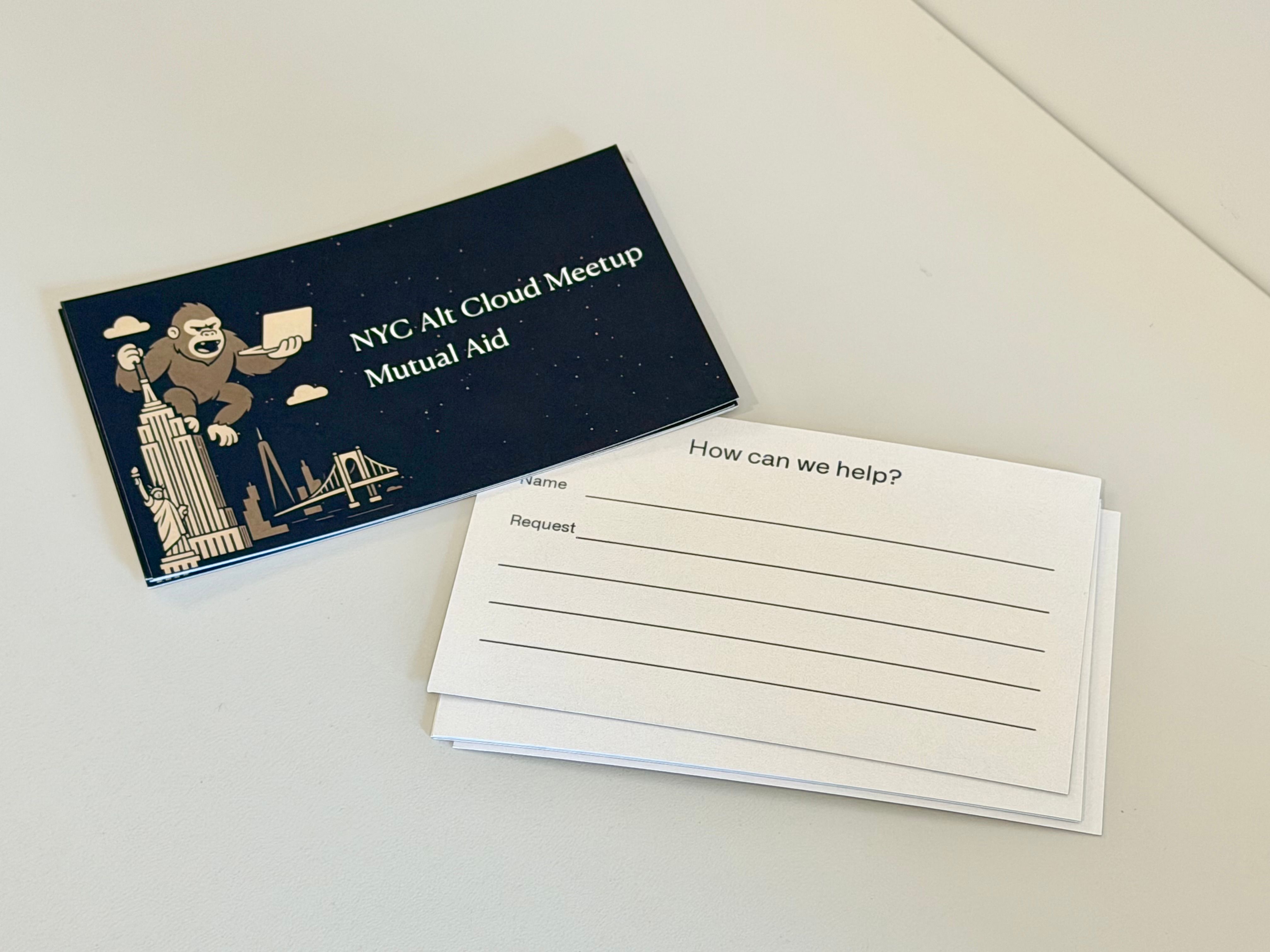
What I love about mutual aid is that it flips the usual meetup dynamic on its head. Instead of everyone showing up to pitch themselves, people show up ready to be useful to each other. It turns out that when you give a room of smart, motivated people explicit permission to ask for what they need, incredible things happen.
Connections get made that wouldn't have happened otherwise. Someone mentions they're stuck on a problem and someone else across the room now has a reason to say hello. It's the kind of magic you can't manufacture, but you can encourage it.
What's Next
Whether it's bringing people together at an Alt Cloud Meetup, organizing our internal weekly kickoff meeting and sendoff email, or creating spaces in our Discord and Community Huddles, the goal is the same: bring people together to connect, share ideas, and build relationships.
While I’m new to the networking and AI community, if my years of building connections in New York taught me anything, it's that the best communities aren't the ones that happen by accident. They're the ones someone decided to care about and tend to, one gathering at a time.
If any of this resonates with you, come find us in person or online. We're just getting started.