

Working with this resource via an AI agent? Datum publishes three skills covering Application Load Balancer: Application Load Balancer (WAF, auth, and traffic policies), Client Traffic (TLS termination, HTTP/3, connection limits), and HTTPRoute (path routing, traffic splitting, redirects).
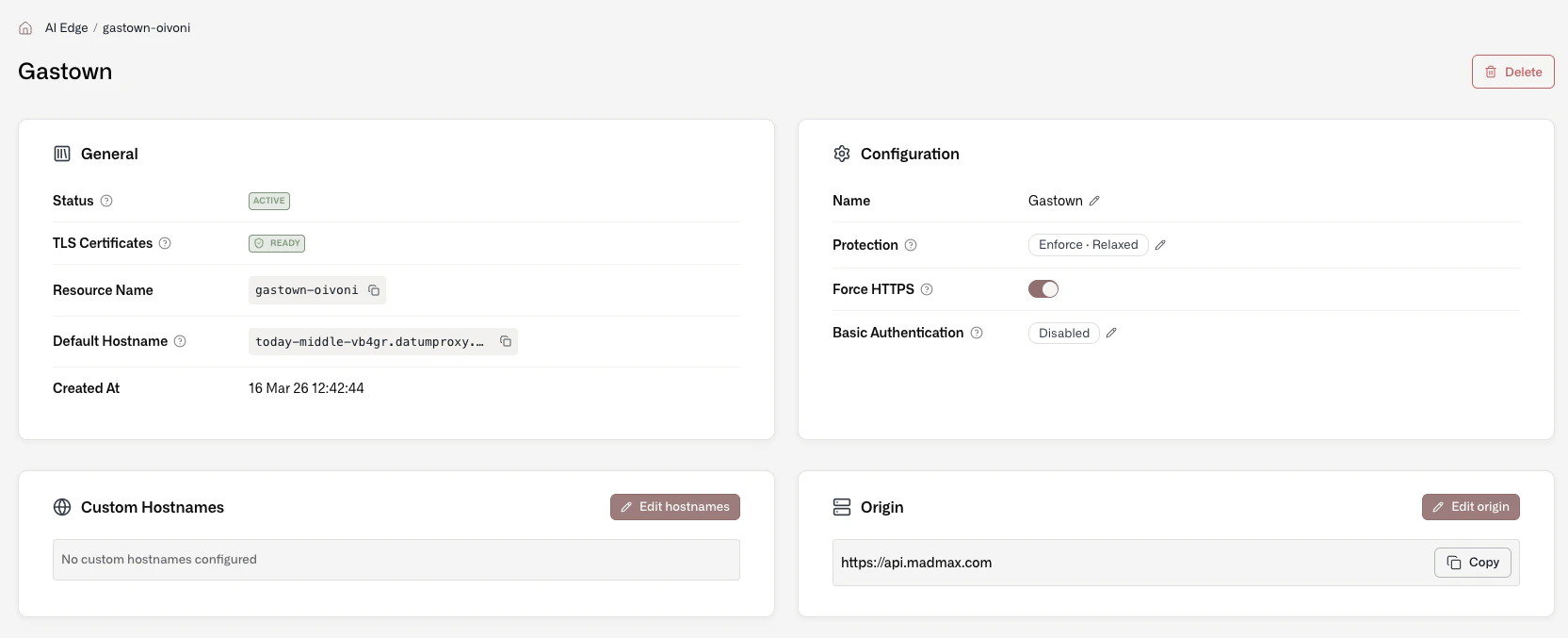
Application Load Balancers can be configured with custom hostnames and protection
What an ALB is made of
In Datum today, an Application Load Balancer is a product experience over several platform resources — not a single API kind. Creating an ALB in the Cloud Portal stitches these together for you:
Portal create always POSTs an
HTTPProxy, then attempts a matching TrafficProtectionPolicy (best-effort today if WAF attach fails). With datumctl, you still apply these resources separately — there is no composite ALB API yet.
See HTTPProxy and WAF Capabilities for schemas and datumctl examples.
Features
Each Application Load Balancer deploys with a default hostname and enforces HTTPS (you can disable this).- Protection - The OWASP Coraza Web Application Firewall (WAF) provides built-in protection. By default, protection runs in “observe” mode. You can set it to enforced status and select either Level 1 (relaxed) or Level 2 (balanced).
- Custom Hostnames – Verify domains (or use already verified domain resources) to use custom hostnames with an Application Load Balancer.
- Basic Authentication - Add a username and password to restrict access to an Application Load Balancer.
- Status – View status “Accepted” and “Programmed”, Generated hostname(s), Custom hostname verification status, and TLS verification status.
- Metrics - The Datum Cloud portal provides a variety of baseline metrics, filtered by region, including: global upstream latency percentile, regional upstream RPS, and regional upstream response.
- Activity Logs - View and filter activity across a project, and filter by resource type (including Application Load Balancer) and action.