As our platform matures, the question of how we’ll charge when we move out of private beta is a frequent one. Early on we played around with a tier-based approach, but our heart just wasn’t in it! Instead, we’re keeping things “simple” and borrowing from the playbook we know and love best: charging for usage.
We believe that platform essentials should be free, that everything else is metered, and volume discounts kick in as you grow. In our public cloud there are no plans to pick, no tiers to graduate through, and no fees for adding a teammate or accessing enterprise-style features like RBAC.
That puts us closer to how the hyperscalers price than many developer platforms. Here’s why.
Removing friction
Many developer and cloud infrastructure platforms include tiers: Free, Pro, Team, Enterprise. Add in a per-seat charge or maybe an upgrade for features like SSO, audit logs, or longer retention. While usage is always in the mix, the DNA of SaaS-style pricing is evident.
There are good reasons companies do this. Tiers are easy to explain and widely adopted in the software world, plus seats provide predictable revenue. And let’s not forget, gated features create a reason to upgrade or encourage engagement with sales. Tiers can also reduce support load and help narrow the adoption focus when a lot of features are at play. This approach works especially well when value scales with the number of humans using it.
Infrastructure is a bit different, especially in the AI era. The value is in the workloads, and agents are doing most of the heavy lifting. A packet or a CPU cycle doesn't care how many people are on your team. When pricing is tied to headcount or plan names, it can feel like friction. Because it is!
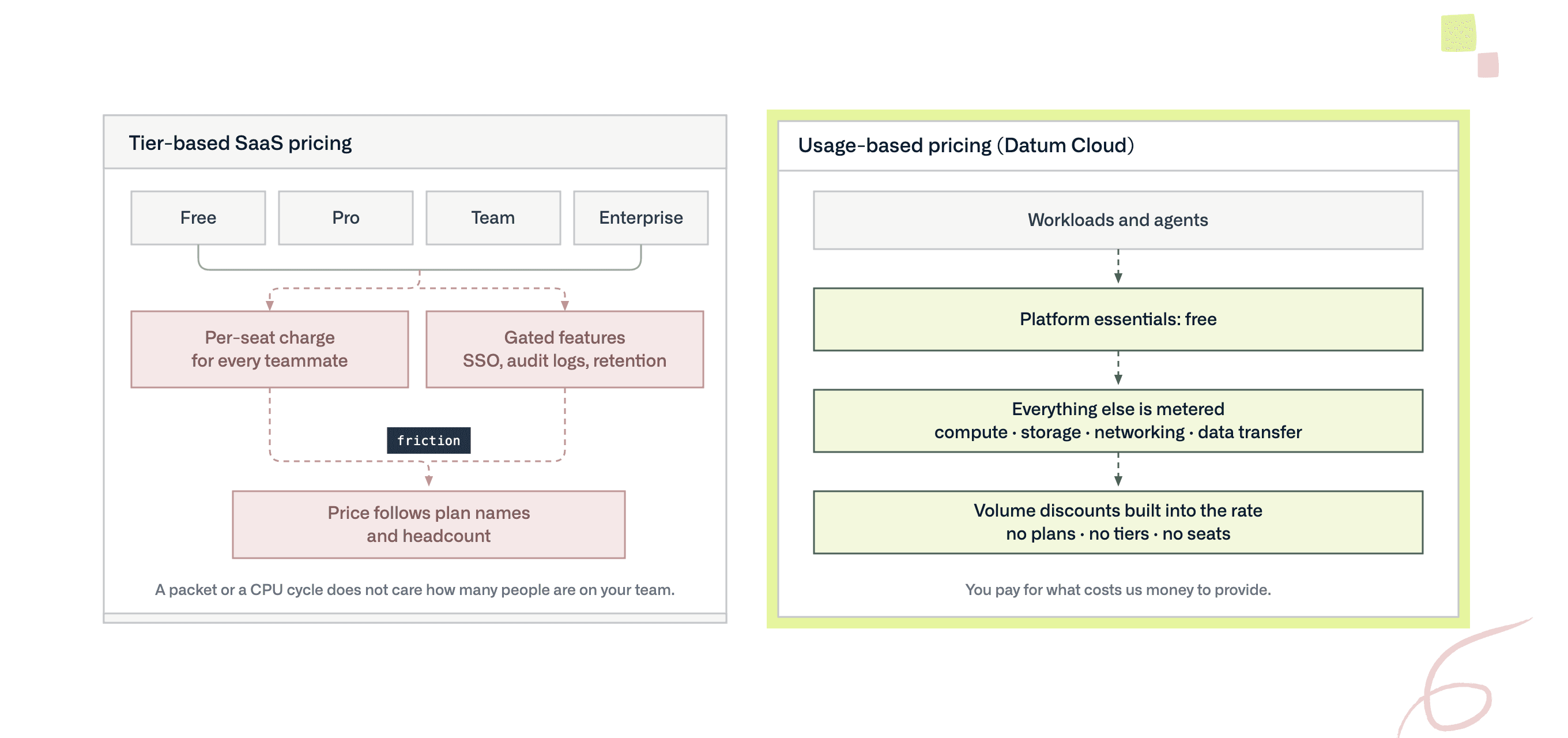
flowchart TB
    subgraph saas["Tier-based SaaS pricing"]
        direction TB
        t["Free · Pro · Team · Enterprise"]:::ext
        s["Per-seat charge<br/>gated features: SSO, audit logs"]:::bad
        t -.-> s
    end
    subgraph use["Usage-based pricing (Datum Cloud)"]
        direction TB
        w["Workloads and agents"]:::ext
        e["Platform essentials: free"]:::datum
        m["Metered: compute, storage,<br/>networking, data transfer"]:::datum
        v["Volume discounts in the rate<br/>no plans, tiers or seats"]:::ok
        w -.-> e -.-> m -.-> v
    end
    saas ~~~ use
Pay for what you use
I think the hyperscalers get it right, at least for public cloud scenarios: pay for resources, by the unit, at a published rate. Nobody at AWS asks how many engineers you have before you launch an instance, or if you’re on the right plan to use a feature. Broadly speaking, the price of a gigabyte is the price of a gigabyte whether you're a two-person startup or an established enterprise.
We think a pure usage model is the most straightforward approach for infrastructure, and it’s a good fit for our customer targets: alt clouds, neoclouds, and AI-native teams with fast-growing, hard to forecast workloads.
Another thing we don’t love is charging for things that don’t cost us much money. For instance, we don't charge for collaborators, and we don't plan to. Seat pricing creates the wrong incentive for infrastructure: it rewards teams for keeping people (and their agents) out of the game. We want to go the other way!
Public to start, committed and dedicated to scale
Datum Cloud is multitenant and available on-demand. Everyone can access it.
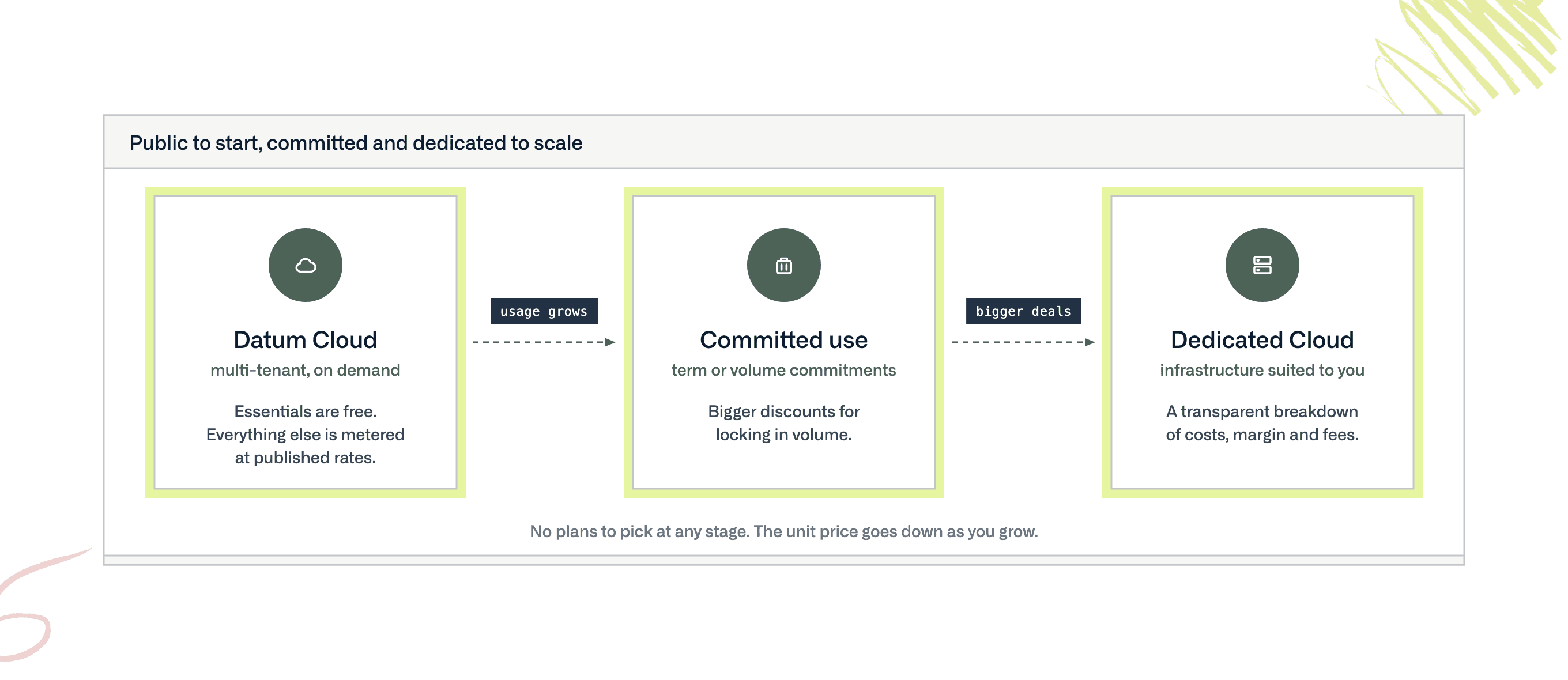
flowchart TB
    pub["Datum Cloud · multi-tenant, on demand<br/>essentials free, the rest metered<br/>at published rates"]:::datum
    com["Committed use<br/>term or volume commitments<br/>bigger discounts"]:::datum
    ded["Dedicated Cloud<br/>infrastructure suited to you<br/>transparent costs, margin and fees"]:::datum
    pub -. "usage grows" .-> com -. "bigger deals" .-> ded
The essentials you need to run on the platform are free, while everything else is metered at published rates across the board. What you pay for is what costs us money to provide: compute, storage, networking, and data transfer.
Volume still matters, so instead of plans we build discounts into the rates. As your usage grows, the unit price goes down. You don't have to ask, upgrade, or sign anything to get it. Our bet is simple: if the price tracks the value, customers grow and we grow with them. Charging for headcount or plan names might make our revenue easier to model, but we think it will make the agent and user experience worse
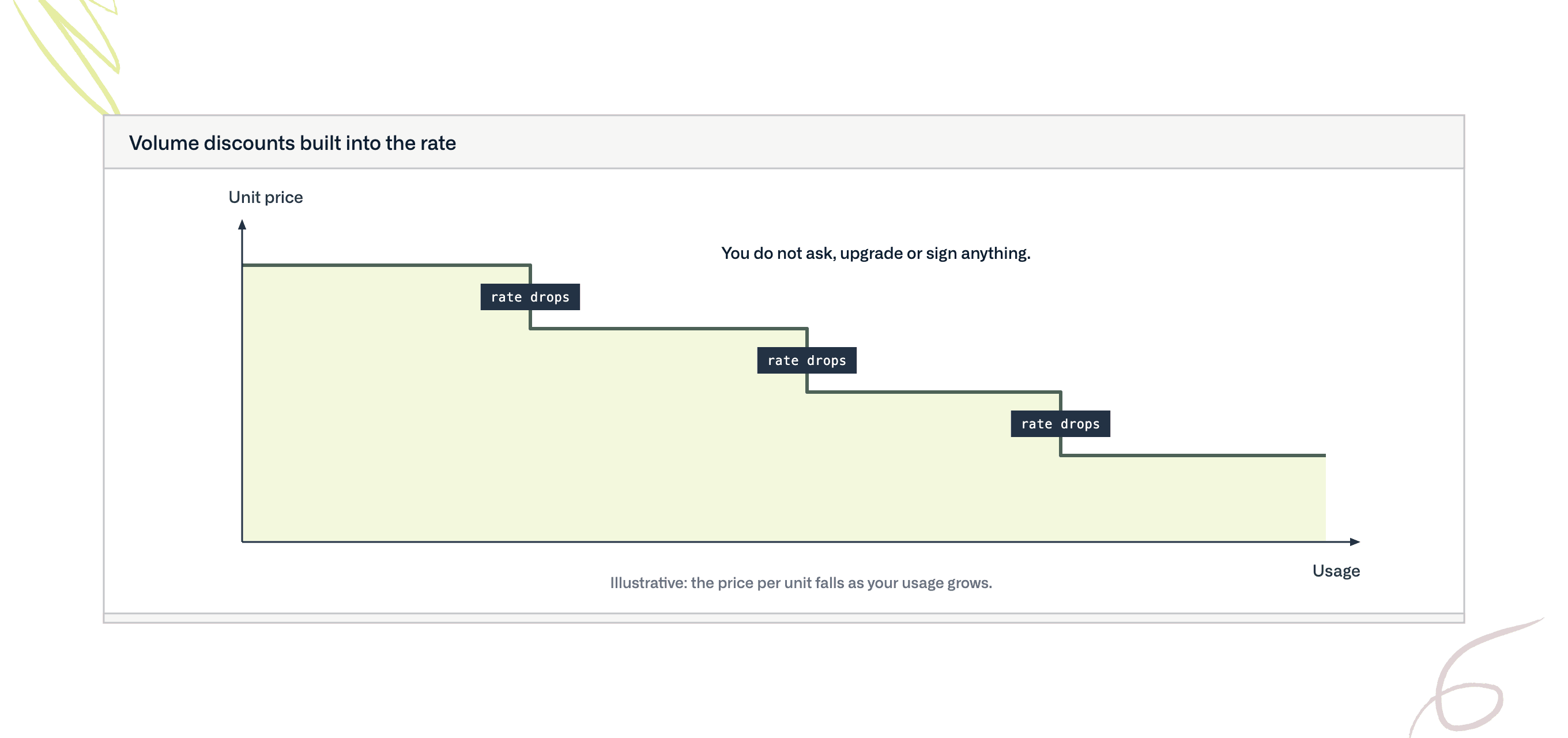
flowchart TB
    u["Usage grows"]:::ext
    p["Unit price steps down<br/>discounts are built into the rate"]:::datum
    k["No ask, no upgrade, no signature"]:::ok
    u -.-> p -.-> k
But what about the big deals?
Our history with infrastructure tells us that service providers need to lock in bigger discounts (usually via term or large volume commitments) and optimize with dedicated infrastructure that is exactly suited to their needs. We offer both options.
On the dedicated cloud side of the house, we provide each customer with a transparent breakdown of our costs, margin, and fees. Since the cost of financing and compute is so high, it doesn’t make sense for us to try and stuff our margin on top of something we didn’t make. Instead, we work with clients to get the best prices and charge for what we uniquely bring to the table: procurement, operations, automation, network / connectivity, etc.
We’re proud to be internet plumbers, making an honest buck for an honest day’s work!